The Manor House
 George Cadbury (1839-1922) purchased what was then known as New House Farm and New House Farm Manor on 25 January 1888 from brothers George and Henry Adkins, and their sister-in-law, Sarah, who had inherited the property upon the death of Sarah's husband, Francis Adkins, six years previously. Francis had bought the property in 1867.
During his two decades of ownership, he had done very little work on the Manor, being content to live in it whilst working the farm. It appears that a member or members of the de Payster Chance family (Chance Brothers & Co., glass manufacturers, Smethwick) rented the house until 1893.
By this time George Cadbury was married to his second wife Elizabeth and they had 11 children. He engaged Franklin Cross to make alterations and enlarge the property. The Cadbury family moved into what they now called the Manor House in December 1894. The farm's name had also changed to just Manor Farm and new farm buildings had been erected, including the so-called 'Cadbury Barn'.
George died in 1922 and in his Will, he stated that the farm should become a public park, in perpetuity. To that end, he created a Charitable Trust (George Cadbury for Public Park) and named the Birmingham Corporation (now Birmingham City Council) as the sole Trustee. Elizabeth continued to live in the Manor House until her death in 1951. Under the terms of her Will, the Manor House, its outbuildings, and a part of the Manor Farm became the property of the University of Birmingham.
A more detailed history of the park and Manor House can be read here.
The interior of the Manor House was converted and used as an off-Campus Hall of Residence until 2007 when the UoB abandoned it; consequently, on the evening of July 30th, 2014, it was attacked by arsonists (the same fate befell the Cadbury Barn three years later, almost to the day).
Unfortunately, following a thorough inspection by structural engineers, it was decided that what remained of the building was unsafe and it was later demolished. The University then sold the grounds to developers for housing.
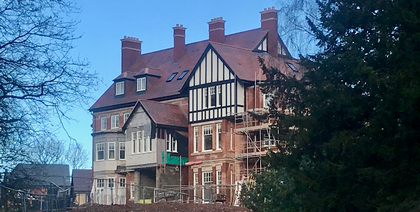
The developers, Crest Nicholson, agreed to erect a block of flats on the site designed to look similar to the original Manor House as the accompanying photograph, taken by a member of FoMFP during the latter stages of the construction, clearly shows.
See what it looks like here.