Waterside Workdays
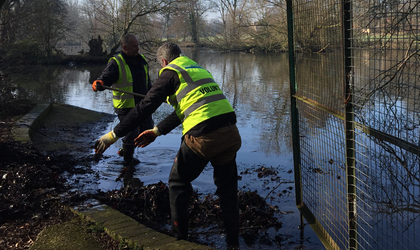 Volunteers maintain the brook and stream in the Park. Once or twice a month, usually on a Sunday morning, they walk along the watercourses and around the lake clearing obstructions, picking up litter and making sure the streams are clean and free running.
Fallen branches and litter create dams that damage the banks and channel beds so we remove them, taking care to ensure we do not harm the habitats of the freshwater invertebrates that live in the water. In the event of unexpected flooding which increases the likelihood of blockages and litter build-up in the waterways, volunteers will be in the park keeping on top of any such issues, whatever the day.
Anyone may join us for WatersideCare activities; having your own Wellington boots is preferable, as we need to be in the water when it is safe to do so; there are other activities related to WatersideCare when it is not. We follow the appropriate Health and Safety guidelines and we provide gloves and hi-viz vests for all our volunteers, including the children.
Keep Britain Tidy, the parent charity of WatersideCare funds our activities, supplying us with tools, gloves, safety wear and training for the Team Leader and Citizen Science volunteers. Unfortunately, this funding discontinues in 2023; however, FoMFP will continue this work with their "FoMFP Waterside Workdays Team" and will fund the activity, though FoMFP has applied to BCC for help with appropriate PLI.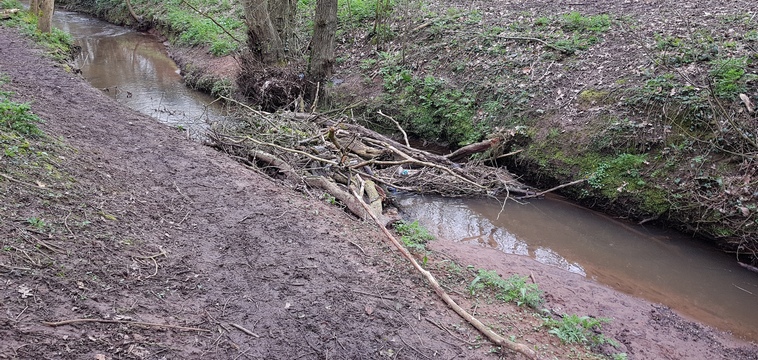
There are two permanent watercourses in the Park: Griffins Brook, which is man-made and created to divert Merrit's Brook from its course through the middle of the Great Meadow immediately after it enters the park from Ley Hill and flows under Shenley Lane. It then winds its way through the park before converging with the outflow from the lake, after tumbling from a spectacular manmade waterfall a few metres downstream from the stepped weir.
The other, Lovell Stream, drains from Shenley Hill and enters the park alongside the Lovell Close entrance and flows into the lake. Because the rate of flow in this stream is always considerably less than pedestrian, late spring/early summer is a perfect environment for the offspring of our amphibious residents and visitors. 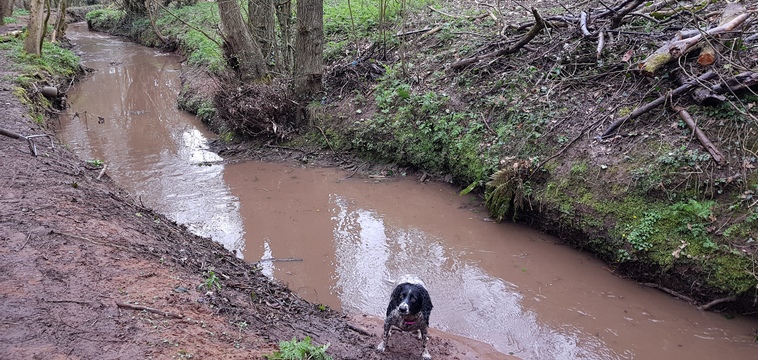
The water quality in our park is very good, enabling freshwater fish, shrimps, mussels, river flies and many other invertebrates to thrive. We are fortunate to have such a wide range of these creatures in our water and it is important that we strive to keep it that way.
Our volunteer work parties have recently restored sections of the lake banks and shored up an island in the lake to help reduce erosion and aid waterfowl nesting. Of course, this work was carried out whilst the lake was drained for de-silting during 2020.
Photographs: before and after a WaterSide Care activity.